
INVT GD20-0R7G-4 3PH 380V frequency converter
Date: 2026年4月21日 Categories: News Views: 199
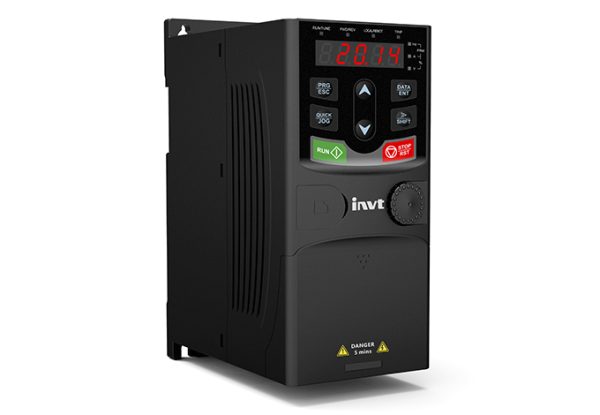 Wide voltage design+instantaneous power failure without stopping, INVT GD20 vector frequency converter ensures production continuity
In industrial sites, voltage fluctuations and instantaneous power outages are common pain points that affect the continuous operation of equipment, which can easily lead to production interruptions, product scrapping, and other losses. The INVT GD20 vector frequency converter has greatly improved the adaptability of the power grid environment and provided a solid guarantee for the continuity of industrial production through its wide voltage range design and instantaneous power-off function.
The GD20 vector frequency converter adopts a wide voltage range design, with single-phase 220V models supporting voltage inputs of AC220V (-15%)~240V (+10%), and three-phase 380V models supporting voltage inputs of AC380V (-15%)~440V (+10%). It can easily cope with large fluctuations in grid voltage and is perfectly suitable for industrial sites with harsh grid environments, effectively reducing the risk of equipment shutdown caused by voltage abnormalities.
At the same time, the INVT GD20 vector frequency converter is equipped with industry-leading instantaneous power failure non-stop function. When there is an instantaneous voltage drop in the power grid, the frequency converter can maintain operation within the effective time by relying on the feedback energy of the motor, avoiding shutdown faults caused by instantaneous power outages. This function is particularly suitable for occasions such as chemical fiber and textile production lines that require extremely high equipment operation continuity. It can effectively reduce production interruptions caused by power grid fluctuations and greatly improve production efficiency and yield. In addition, the product is equipped with overvoltage stall and overcurrent stall control functions, which can automatically adjust the output frequency during acceleration and deceleration to avoid overvoltage and overcurrent faults caused by too fast acceleration and deceleration, further improving the stability of equipment operation.